Scan Data Matrix codes in your web app
Scan Data Matrix codes directly in your web apps using STRICH Barcode Scanning SDK
What is a Data Matrix code?
Data Matrix is a high-density, 2D matrix code widely used in manufacturing, healthcare, logistics and retail for efficient data encoding and retrieval. Data Matrix is standardised as ISO/IEC 16022 and GS1 Data Matrix.

Data Matrix consists of a square or rectangular matrix of black and white cells bordered by a solid, L-shaped finder pattern on the left and bottom sides, and an alternating strip of black and white on the upper and right sides, the timing pattern. The code must be surrounded by a small amount of empty space, the quiet zone.
Data Matrix is known for being high-density, allowing considerable amounts of data to be packed into a compact space. It is often seen on small items, packaging and electronic components.
Data Matrix has strong error correction based on Reed-Solomon (ECC 200), ensuring accurate reads even if the code is partially damaged or obscured.
Square Data Matrix sizes and capacity
Data Matrix codes are usually square and come in a fixed number of sizes, from 10x10 up to 144x144 rows/columns. Data Matrix codes can store numeric (digits) and alphanumeric (characters and digits) data.
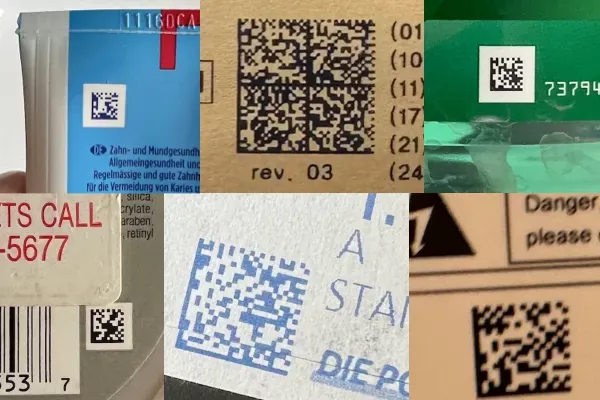
Increasing the number of rows and columns increases the code's capacity, but also makes the code harder to read. The table below lists the code capacities in numeric and alphanumeric mode for each size.
| Size | Capacity num/alpha | Size | Capacity num/alpha |
|---|---|---|---|
| 10x10 | 6/3 | 44x44 | 288/214 |
| 12x12 | 10/6 | 48x48 | 348/259 |
| 14x14 | 16/10 | 52x52 | 408/304 |
| 16x16 | 24/16 | 64x64 | 560/418 |
| 18x18 | 36/25 | 72x72 | 736/550 |
| 20x20 | 44/31 | 80x80 | 912/682 |
| 22x22 | 60/43 | 88x88 | 1152/862 |
| 24x24 | 72/52 | 96x96 | 1392/1042 |
| 26x26 | 88/64 | 104x104 | 1632/1222 |
| 32x32 | 124/91 | 120x120 | 2100/1573 |
| 36x36 | 172/127 | 132x132 | 2608/1954 |
| 40x40 | 228/169 | 144x144 | 3116/2335 |
Rectangular Data Matrix sizes and DMRE
Rectangular Data Matrix codes are less common than square ones. These codes are often used on postage, retail items or containers.
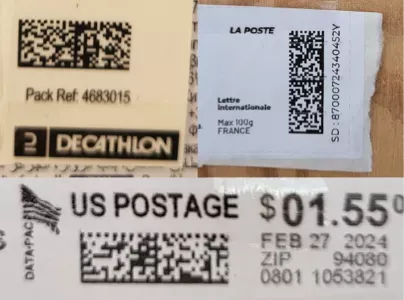
ISO/IEC 16022 defines six rectangular sizes, ranging from 8x18 to 16x48 rows/columns. The table below lists the code capacities for each size.
| Size | Capacity (numeric/alphanumeric) |
|---|---|
| 8x18 | 10/6 |
| 8x32 | 20/13 |
| 12x26 | 32/22 |
| 12x36 | 44/31 |
| 16x36 | 64/46 |
| 16x48 | 98/72 |
STRICH supports all six rectangular sizes since version 1.14.0. The 18 additional rectangular sizes defined in ISO/IEC 21471 (Data Matrix Rectangular Extension, DMRE), which extend up to 26x64 rows/columns, will be supported in a future release.
For more information on the Data Matrix symbology and how the SDK supports it, please refer to our SDK documentation.
Scanning Data Matrix codes in JavaScript
With the STRICH barcode scanning SDK, scanning Data Matrix codes in a web app takes just a few
lines of JavaScript: initialize the SDK with your license key and enable the
datamatrix symbology. Scanning runs entirely on the device, in the browser.
Pick the integration that fits your app:
Built-in scanning UI with PopupScanner
The PopupScanner opens a dialog with a camera preview and returns the scanned codes. It is the quickest way to add scanning to an existing form.
import { StrichSDK, PopupScanner } from '@pixelverse/strichjs-sdk';

await StrichSDK.initialize('<your license key>');

const detections = await PopupScanner.scan({
    symbologies: ['datamatrix']
});
if (detections) {
    console.log(detections[0].data);
}
Embedded scanner with BarcodeReader
For full control over layout and scanning flow, the BarcodeReader renders the camera preview inside an element of your page and keeps scanning until you stop it, which is ideal for scanning many items in a row. The host element needs a known size:
<div id="scanner" style="position: relative; height: 240px"></div>
Each detection contains the decoded data, the symbology identifier (]d2 for
GS1 Data Matrix) and Data Matrix metadata
such as the symbol size:
import { StrichSDK, BarcodeReader } from '@pixelverse/strichjs-sdk';

await StrichSDK.initialize('<your license key>');

const barcodeReader = await new BarcodeReader({
    selector: '#scanner',
    engine: {
        symbologies: ['datamatrix'],
        // enable for light-on-dark codes, e.g. laser-etched part markings
        invertedCodes: false
    }
}).initialize();

barcodeReader.detected = (detections) => {
    for (const detection of detections) {
        // ]d2 is the symbology identifier for GS1 Data Matrix
        const isGS1 = detection.symbologyIdentifier === ']d2';
        const { rows, cols } = detection.metadata;
        console.log(detection.data, isGS1, `${rows}x${cols}`);
    }
};
await barcodeReader.start();
Reading Data Matrix codes from images with ImageScanner
If the codes come from photos or screenshots instead of a live camera, the ImageScanner decodes them from a file, an image element or a blob:
import { StrichSDK, ImageScanner } from '@pixelverse/strichjs-sdk';

await StrichSDK.initialize('<your license key>');

// e.g. from an <input type="file" accept="image/*">
const file = document.querySelector('input[type=file]').files[0];
const detections = await ImageScanner.scan(file, {
    engine: { symbologies: ['datamatrix'] }
});
For more information on Data Matrix support in STRICH, please refer to our SDK documentation.
Open-source alternatives
Not all open-source JavaScript barcode scanners read Data Matrix codes: Quagga2, for example, only supports 1D barcodes. Our comparison of open-source JavaScript barcode scanner libraries shows which libraries support which symbologies, with live code snippets for each.
Try it online
Want to see how STRICH handles your codes? Open the STRICH demo app on your smartphone and scan a Data Matrix code with the camera, no app install or sign-up needed. To read a code from a photo or screenshot, use our free online barcode scanner.
Frequently asked questions about Data Matrix
What is a Data Matrix code?
Data Matrix is a 2D barcode made of black and white cells, recognizable by its solid L-shaped finder pattern and the alternating timing pattern on the opposite sides. It is standardized as ISO/IEC 16022 and is widely used in manufacturing, healthcare, logistics and retail.
How much data can a Data Matrix code hold?
It depends on the size. The largest square Data Matrix, 144x144, holds up to 3116 digits or 2335 alphanumeric characters. The smallest, 10x10, holds 6 digits or 3 alphanumeric characters.
What is the difference between Data Matrix and QR Code?
Both are 2D barcodes. Data Matrix uses an L-shaped finder pattern and is very compact for small amounts of data, which is why it is popular for marking small parts, packaging and medication. QR Code uses three square finder patterns in the corners and is more common in consumer-facing use cases. STRICH reads both.
What is GS1 Data Matrix?
GS1 Data Matrix is a Data Matrix code that encodes data according to the GS1 standards, using Application Identifiers for values like the GTIN, expiry date, batch and serial number. It is the standard for marking pharmaceuticals and medical devices. STRICH scans GS1 Data Matrix codes, read more about GS1 standards support.
Can I scan Data Matrix codes with a smartphone browser?
Yes. With STRICH, Data Matrix codes are scanned with the smartphone camera directly in a web app, without installing a native app. Scanning runs entirely on the device and also works offline. Try it with the STRICH demo app.
Does STRICH support rectangular Data Matrix and DMRE?
STRICH supports all six rectangular sizes defined in ISO/IEC 16022 since version 1.14.0, from 8x18 to 16x48. Support for the additional rectangular sizes of the Data Matrix Rectangular Extension (DMRE, ISO/IEC 21471) is planned for a future release.
Can STRICH read small Data Matrix codes, like those on medication vials?
Yes. Small codes require a camera with good autofocus, but STRICH is built to read them reliably. Schedule2 uses STRICH to scan the small GS1 Data Matrix codes on vials in emergency medical services, read the Schedule2 case study.
Can STRICH read Data Matrix codes on curved surfaces?
Yes. Data Matrix has no anchor points inside the code, which makes curved surfaces like bottles or labels on fresh produce challenging. STRICH 1.17 improved decoding on curved surfaces.
Can a damaged Data Matrix code still be read?
Often, yes. Data Matrix ECC 200 uses Reed-Solomon error correction, so a code can be read even if part of it is damaged, dirty or obscured.
What information does STRICH return when scanning a Data Matrix code?
Besides the decoded data, STRICH returns metadata such as the size in modules (rows x columns) and Structured Append information if present. See DataMatrixMetadata in the API reference.
Still have questions? Check out the full FAQ.